Leadership Presence

Leadership presence is the clarity, composure, and credibility a CEO brings into moments. It shapes how people experience the leader during conversations, reviews, decisions, conflict, and uncertainty. Leadership Presence is the hallmark of successful Leaders.

Leadership Presence enhances leader’s ability to inspire, influence and impact. Leadership Presence of Great Leaders is felt even in their absence.

Leaders with heightened Leadership Presence generate significant Leadership Impact.

 

Continue reading to explore the essential constituents and finer nuances of leadership presence, how leaders can consciously build it, the common challenges they encounter, and the practical ways to overcome them.

Leadership presence encompasses executive presence and much more. Leaders with Leadership Presence look comfortable, composed, humble, and involved. Such leaders exude warmth and appear inclusive and approachable. They communicate with clarity, brevity, and respect. They simplify things. They display a higher sense of emotional awareness.

Leaders with Leadership Presence listen; they appear open, curious, clear, authentic, trustworthy, consistent, resolute and resilient.

Leadership Presence is not necessarily something we are born with; it’s something we learn. The good news is that we can build, enhance and strengthen our Leadership Presence working with a CEO Coach.

Since 2013, As a CEO Coach I have been supporting CEOs, founders and business leaders scale-up their Leadership Presence. Working with me, Leaders are able to simplify, unpack complexities, uncover blind spots, communicate with clarity and brevity, amplify their ability to see things as they are, gain better emotional regulation, listen actively and amplify their leadership effectiveness significantly.

How to Enhance My Leadership Presence?

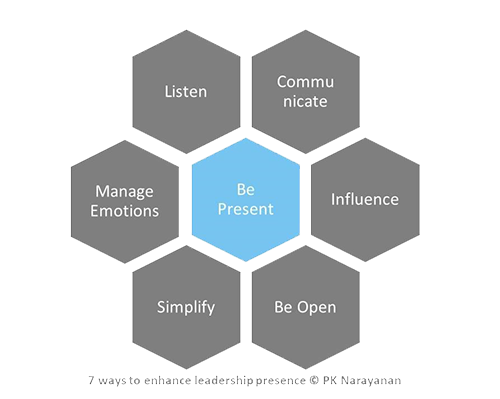
My 7-step Leadership Presence ModelTM helps in enhancing your leadership presence significantly. Here are the steps:

  1. Being present is the essence of Leadership Presence.

‘Wherever you are, make sure you’re there’, said Dan Sullivan.

One could consciously work on being present – in whole, every moment, in every role, wherever we are – with the people we are, with a message we are reading or listening to, with an email that we are drafting, in a situation we are in, in whatever we do.

In a way, presence means involvement, focusing on one thing at a time, shutting out distractions.

Presence enables one to do more, influence more, be in more places, get more done, thereby improving leadership effectiveness as well.

3. Communicating effectively with clarity and brevity, in a timely manner, enhances one’s leadership presence. There are nuances and subtilities in communication that a leader needs to be conscious of.

For example, speaking at a slow pace increases a Leader’s chance of being listened to, and understood. Speaking at a slower pace allows one to communicate consciously; and provides the much-needed space to choose the appropriate words to articulate clearly. It also allows better control over tonality and voice modulation to convey what is intended effectively.

When one Speaks Slowly, it exudes confidence, composure, and respect for the listener.

Speaking Slowly helps listeners develop interest, follow, understand, and digest one’s message. It increases comprehension and engagement, making communication more effective.


2. Listening enhances one’s Leadership Presence.

Listening to ‘What’s Said’ is relatively common. Leaders need to listen to even ‘What’s Unsaid’.

People often say certain things in conversations and choose not to say certain things; they just stop short of saying what they really want to say. Listening deeply helps one pick up cues, listen to the emotions behind spoken words, tap into deeper meanings, needs and feelings that are unsaid, and ask clarificatory questions to gain clarity on what’s left unsaid and what they are trying to convey.

Also, listening requires courage.

Listening cultivates trust and respect. It helps understand the context better. It leads to greater clarity and improved positive relationships enhancing leadership effectiveness.

A leader needs to listen deeply. The good news is that it’s possible for one to consciously practise and develop listening skills. Leaders may take the support of a CEO Coach here.

4. Ability to Influence people is a hallmark of successful leaders. Ability to influence also enhances one’s leadership presence.

A host of aspects determine one’s ability to influence others – whether it be internal teams, peers, other leaders, customers, or any other stakeholders. When leaders are aware of the nuances of influencing, and consciously practices them, their ability to inspire and impact gets amplified.

For example, Positive Relationships – it refers to those relationships that are characterised by mutual respect, trust, care, and understanding. Positive Relationships often result in the display of authenticity, genuineness, compromise, and compassion. Such relationships usually lead to higher influence, positive outcomes and improved performance. Leadership coaching could help leaders enhance their ability to influence.

.

5. Being Open is a key enabler for higher levels of leadership presence.

Great leaders are curious.

‘Smart leaders keep constantly revising their understanding, reconsidering a problem they thought they had already solved. They are open to new points of view, new information, new ideas, contradictions, and challenges to their own way of thinking’ – Jeff Bezos.

Leaders are open to the world; they are Curious about the possibilities. It allows one to include and embrace new ideas. It also enhances one’s ability to change. A Growth Mindset supplements one’s ability to be open and curious.

For example, receiving diverse views and feedback with an open mind is important for a leader – especially when making choices and taking decisions.

6. Simplifying enhances one’s leadership effectiveness.

Simplifying the strategy provides clarity to the Team. Simplifying the execution inspires the team and helps them execute smoothly, faster, and with excellence.

Simplifying communication delivers clarity to teams, customers, and stakeholders.

Embracing a Simplifying Mindset holds the key to simplifying many aspects of the Business. When integrated into one’s business approach, Simplifying can be a game-changer.

When we simplify, things get done; Simplifying leads to disproportional gains. Executive coaching could help leaders simplify.

7. Being an effective leader calls for higher levels of Emotional Awareness.

It involves being aware one’s own emotions, and emotions of others. Great Leaders are able to bring higher levels of emotional regulation, calm, and balance to their role.

Effective leaders care for others. Compassionate Leaders create an environment where others feel safe, respected, supported, heard, and valued. They develop meaningful emotional connections at the workplace leading to a healthy work culture.

Common CEO Challenges, and How Heightened Leadership Presence Can Make a Difference

As businesses grow, the role of the CEO changes fundamentally – the demands are no longer confined to being a problem-solver or making sound decisions or delivering financial results. Every interaction, every conversation, and every response begins to send signals to many, and start shaping the organisational culture, and how the organisation perceives what to do, and how.

This is where CEO’s leadership presence becomes such an important element determining the very future course of the business.

The following challenges commonly faced by CEOs can be tough even for the experienced ones:

  1. Lack of Presence

As organisations expand, CEOs carry multiple priorities simultaneously—customers, investors, strategy, talent, profits, governance, and execution. Their mind space and attention is constantly divided. In conversations, they may be physically present somewhere but mentally solving the next problem. Teams quickly notice this. When leaders appear distracted, they unintentionally signal that people or discussions are less important than they truly are.

Genuine presence requires the discipline to give complete attention to the person and the moment at hand. Consciously.

3. Blurred Communication

As businesses grow, leadership communication becomes increasingly difficult. What appears perfectly clear in the CEO’s mind may become diluted across multiple organisational layers. Messages become either too detailed, too short, too abstract, or inconsistent across audiences.

Effective communication is not about speaking more; it is about ensuring that people understand the purpose, priorities, expectations, and outcomes with brevity, and clarity.

5. Business Complexities

As businesses scale, complexities grow exponentially. Markets evolve, organisations become layered, and decisions involve more variables than ever before. CEOs often find themselves immersed in complexity instead of simplifying it for oneself and others.

Yet one of the key responsibilities of a leader is to convert complexity into clarity. That requires a simplifying mindset.

Teams execute better when priorities are simplified, decisions are structured, strategic direction and communication become easy to understand.

7. Emotional Imbalances

Perhaps the greatest challenge for CEOs is managing themselves while leading others. Business uncertainty, difficult decisions, market pressures, and organisational expectations create continuous emotional demands.

Under stress, even accomplished leaders can become impatient, reactive, defensive, or withdrawn. Teams take emotional cues from their leader. A CEO’s ability to remain composed, deliberate, and balanced during periods of uncertainty creates psychological safety and confidence across the organisation.

In all of these challenging situations, enhanced leadership presence can come handy for a leader. A leader can be ably supported by a CEO Coach in this journey.

Leaders with heightened leadership presence communicate with greater clarity, build stronger relationships, inspire higher levels of trust, and create an environment where people perform at their best.


2. Shallow Listening

Many CEOs reach their position because they are decisive problem-solvers. Over time, this strength may become a limitation. Instead of listening to understand, they begin listening to respond, advise, or conclude. Meetings become shorter, conversations become transactional, and valuable insights remain unspoken.

Active listening is not a passive leadership skill—it is a leadership capability that uncovers risks, encourages innovation, strengthens trust, and enables better decisions. It’s key in creating leadership leverage across the business.

4. Lack of Openness

With seniority often comes the unintended consequence of isolation. People become more cautious about disagreeing with the CEO, and the CEO receives progressively filtered information. Over time, leaders may unknowingly become less receptive to alternative viewpoints or constructive challenge.

Openness requires intellectual humility—the willingness to question one’s own assumptions, invite diverse perspectives, and create an environment where honest conversations are encouraged rather than avoide

6. Conflicts, Resistance

In growing organisations, formal authority alone is no longer sufficient. CEOs increasingly need to align diverse stakeholders—leadership teams, investors, customers, vendors, partners, and employees—who may have competing priorities.

Influence is earned through a host of aspects – such as credibility, authenticity, trust, care,  consistency, and the ability to connect people to a shared purpose, to name a few.

Leaders who rely primarily on position or hierarchy often experience resistance rather than genuine commitment.

 

What are the Benefits when Leadership Presence shifts

Here are a few instances where enhanced leadership presence made transformational difference to the leaders and their businesses:

1. A founder-CEO was navigating rapid growth, customer escalations, and pressure on deliveries. In review meetings, urgency often became visible frustration. Senior leaders began bringing only ‘safe’ updates, delaying the surfacing of real issues.

On a leadership coaching journey, we worked on Emotional regulation, practicing deliberate calm, discipline of responding, and creating a more constructive operational review rhythm.

The shift became apparent – The CEO consciously practiced pause before responding, kept separating facts from emotion, and asked clearer questions before taking decisions. Leadership meetings became more candid, issues surfaced earlier, and the team experienced better alignment, greater clarity and confidence while facing high-pressure periods.

2. A capable professional CEO was respected for his expertise but was perceived as overly detailed and operational. Messages were technically strong but failed consistently to create alignment and commitment among Senior leaders and stakeholders.

On an executive coaching engagement, we worked on simplifying complexities, effective communication, and influencing.

Shift was noticeable – The CEO began leading with a strategic point of view, clarifying the decision wherever required, and adapting the message to different audiences. Conversations became sharper, decision-making improved, and the CEO’s influence across senior leaders and stakeholders strengthened.

3. A founder CEO had built the business through speed, strong instincts, and personal involvement in key decisions. Even after becoming a medium to large enterprise, the leadership team increasingly waited for direction from the CEO instead of acting independently.

On a CEO Coaching journey, we worked on leadership presence, active listening, being open to alternate views, and creating ownership in the leadership team.

Impact was visible – Senior leaders demonstrated stronger ownership, more issues started getting resolved at the lower level, and the CEO was able to free-up time from operational fire-fight to focus on long-term affairs and strategic priorities.

Frequently Asked Questions

Leadership presence is the clarity, composure, and credibility a CEO brings into moments. It shapes how people experience the leader—during conversations, reviews, decisions, conflict, and uncertainty. As the business grows, it calls for higher levels of leadership presence from the CEO and senior leaders. Leadership presence increasingly influences trust, alignment, execution, and the organisation’s ability to grow.

No. Effective communication is an important part of leadership presence, but it is much broader. It includes being fully present, listening actively, remaining open to different perspectives, simplifying complexity, influencing stakeholders, and regulating emotions under pressure. It is reflected not only in how a CEO speaks, but also in how they listen, respond, decide, and lead others. In short the ‘being’ of the CEO.

Leadership presence can be developed. For a leader, it is part of leadership development, building their leadership skills for being a CEO. It is not dependent on being naturally charismatic, extroverted, or forceful. Through creating greater self-awareness, reflection and deliberate practice, CEOs can strengthen their leadership presence. A CEO Coach could help a leader substantially in this journey.

Training typically builds general skills in a group setting. One-on-one Coaching works with the CEO’s specific leadership context, behavioural patterns, stakeholder dynamics, and current or future business needs and challenges. The focus is not merely on learning techniques, but on creating sustained shifts in how the leader shows up in real situations that matter.

Becoming a high-impact leader – with increased influence, improved decision quality, greater calm under pressure, sharper communication, more productive leadership-team conversations, clearer priorities, simplified approach, and increased leadership leverage across the organisation. The specific coaching focus is shaped around the CEO’s current leadership context and demands of the business.

No. Many capable CEOs choose to work on leadership presence not because something is broken, but because the next stage of growth requires a different level of leadership from them. As complexity, scale, and stakeholder expectations rise, the CEO may need to evolve –  from being ‘highly capable’ to ‘a high-impact leader’, creating greater clarity, influence, and momentum across the organisation.

Let’s schedule an Impact Elevation Call, a focused 20-minute conversation, designed to help CEOs, Founders gain awareness on specific shifts required to lead the business forward with greater presence and clarity.

As a business owner, am I prepared to Scale-up?

Take this short quiz and
figure out for yourself!

Simplify! Get things done!

Download this prompter E book!
And many more…