
Leadership Impact
Become a High-Impact CEO
Create the clarity, leadership leverage, ownership, and execution momentum that your business needs.
Leadership impact is a consequence of the CEO’s ability to improve decision quality, focus, ownership, and execution across the organisation—not through personal effort alone, but by creating leverage through people and systems.
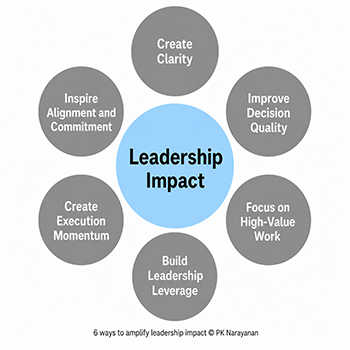
PK’s Leadership Impact Model supports capable CEOs to become high-impact leaders.
PK’s Leadership Impact Model:
How to become a High-Impact Leader?
1. Create Clarity
High-impact CEOs simplify complexity. They help people understand what matters, why it matters, what success looks like, and what needs to happen next.
2. Improve Decision Quality
High-impact CEOs improve not only their own decision-making, but also the quality and speed of decisions across the leadership team and organisation.
3. Focus on High-Value Work
High-impact CEOs protect time and attention for the work that truly moves the business forward, rather than allowing urgency, noise, and operational detail to consume their leadership bandwidth. They deliberately create time for what matters most.
4. Build Leadership Leverage
High-impact CEOs do not become the answer to every issue. They develop leaders who think independently, take ownership, make sound decisions, and execute without constant CEO intervention.
5. Create Execution Momentum
High-impact CEOs establish direction, accountability, review rhythms, and follow-through so that strategic intent translates into consistent execution.
6. Inspire Alignment and Commitment
High-impact CEOs inspire people, influence stakeholders, nurture positive relationships, and build the trust required for people to move together toward shared outcomes.
Leadership impact is not created through authority alone. It is enabled by leadership presence – the way CEO shows up: present, open, clear, respectful, curious, and composed.
Why Even Capable CEOs Struggle to Create Leadership Impact at Scale
As a business grows, the key constituents of the CEO’s role changes. The work is no longer only about making good decisions, solving important problems, or driving key relationships. It is increasingly about improving the quality of thinking, decision-making, ownership, and execution across the organisation.
This transition is not always easy. CEO coaching could support the CEO here.
Here are some of the common challenges faced by CEOs while creating leadership impact:
1. Many CEOs have built their success through personal capability—strong judgement, speed, resilience, deep involvement, and the ability to solve problems. These strengths remain valuable. Yet, at a larger scale, the same may not be good enough to support the business; and at times even can unintentionally limit organisational capacity and business growth.
3. Complexity compounds the challenge. As the organisation expands, there are more priorities, stakeholders, functions, people, markets, risks, and competing demands. Without deliberate simplification, people can lose sight of what matters most. Messages become diluted across layers, and Reviews become task updates rather than moments that create clarity, accountability, and forward movement.
5. Letting go is difficult. Developing capable leaders requires a CEO to shift from providing answers to improving the quality of questions, thinking, and decisions around them. This means allowing others to take ownership, make informed choices, learn from experience, and become stronger leaders. It requires patience, trust, and an ability to resist the urge to provide answer to every issue.
2. When Senior leaders remain dependent on the CEO for direction, prioritisation, or resolution, the business may appear busy and committed, while decision quality, ownership, and execution momentum remain sub-optimal and below par.
4. Urgency can consume leadership bandwidth. CEOs are often drawn into operational matters, customer escalations, people issues, and immediate opportunities. Important work – strategic thinking, leadership development, succession, stakeholder alignment, and future-oriented decisions – gets deferred repeatedly. The leader remains highly active, but not always focused on the work that creates the greatest leverage for the business.
6. Leadership impact also depends on the CEO’s ability to create alignment across diverse stakeholders. Leadership teams, customers, investors, partners, and employees may all hold different priorities. Authority can secure compliance, but it does not always create shared commitment. High-impact CEOs build trust, clarify the larger purpose, and influence people to move together towards meaningful outcomes.
The shift, therefore, is not from working hard to working less. It is from being personally effective to making the organisation more effective.
Why becoming a high-impact CEO is important:
A high-impact CEO simplifies, and creates clarity where there is complexity, improves decision quality where there is hesitation, builds ownership where there is dependency, and establishes execution rhythm where there is drift.
The result is not simply a stronger CEO, but a stronger leadership system around the CEO.
Leadership impact does not improve through more effort alone. It improves when a CEO becomes more deliberate about where attention goes, how decisions are made, how leaders are developed, and how execution is reviewed.
PK’s Coaching provides a confidential thinking space to examine these patterns in the CEO’s real business context, and enable them become high-impact leaders.
How high-impact leadership has made transformational difference to the leaders and their businesses:
Here are some examples of shifts in Leadership Impact experienced through CEO Coaching by the CEOs working with me:

1. A founder CEO of an INR 1,800+ crore business had built the organisation through sound judgement, speed, and close personal involvement. As the business grew, however, senior leaders increasingly waited for the CEO’s direction and decisions. This created operational overload, leaving insufficient time and attention for the strategic priorities and longer-term interests of the business.
Through the CEO coaching journey, the CEO re-prioritised where his time and attention created the greatest value, while enabling senior leaders to make sound decisions with greater clarity, confidence and ownership.
As a result, the CEO shifted more than 12 hours each week from operational firefighting to high-value work, focused on strategy and longer-term aspects of the business.
2. A professional CEO of INR 300+ Crore business was managing multiple business priorities of a scaling business. While deeply involved in the business, recurring operational escalations—particularly schedule overruns—continued to demand significant time and attention of the CEO. This was affecting strategic momentum and long-term value creation adversely.
CEO Coaching helped clarify what genuinely required CEO attention. The CEO began operating with sharper priorities, stronger boundaries, and a more disciplined business review rhythm.
Over the 120 days’ time, the CEO reported an improvement of up to 55% in execution effectiveness.
Frequently Asked Questions
Leadership impact is a consequence of the CEO’s ability to improve decision quality, focus, ownership, and execution across the organisation—not through personal effort alone, but by creating leverage through people and systems.
A high-impact CEO does not carry the business alone. They build the leadership capacity that enables the business to move forward with greater clarity and discipline.
It’s broader than that. Business results matter, but leadership impact is also seen in the quality of thinking, relationships, leadership capability, decision-making, and execution across the organisation. These are often the conditions that make stronger business outcomes possible and more sustainable.
This work is most relevant for capable CEOs whose businesses are scaling, or becoming more complex, layered, or demanding. It is valuable when the CEO senses that personal effort alone is no longer enough—and that the next stage of growth requires greater clarity, leadership leverage, ownership, and execution momentum across the organisation.
Leadership presence is how a CEO is experienced by others—through clarity, composure, listening, communication, openness, emotional regulation and influence.
Leadership impact is the organisational effect created by that leadership presence: better decisions, stronger ownership, clearer priorities, and consistent execution.
Yes. High-impact leadership can be developed – through greater self-awareness, stronger leadership presence, conscious use of time and attention, and deliberate shifts in how a CEO leads people and systems. Working with a CEO Coach supports this journey significantly.
Let’s schedule an Impact Elevation Call, a focused 20-minute conversation, designed to help CEOs, Founders gain awareness on specific shifts required to lead the business forward with greater presence and clarity.
As a business owner, am I prepared to Scale-up?
figure out for yourself!
